

This week, CLF is intervening before the British Columbia Supreme Court in the matter of O’Neill v. British Columbia (Minister of Health). CLF’s factum (written submissions to the court) is posted below.
This case involves a constitutional challenge to a religious accommodation, adopted by the B.C. Government, that protects faith-based organizations from being forced to have assisted suicide/euthanasia (also known as medical assistance in dying, or “MAID”) performed within their premises.
The claim has been brought by Dying With Dignity, as well as an individual physician, and a family member of a patient who was previously admitted to a hospital operated by Providence Health Care Society (“Providence”), which is affiliated with the Roman Catholic Church. That patient sought MAID, but because the hospital (St. Paul’s) does not provide it, she was transferred to another facility, where MAID was performed the same day.
No one has argued that patients seeking MAID have been unable to access it as a result of this policy. However, the plaintiffs argue that, because the government does not require MAID to be offered in religious hospitals, this imposes additional burdens and distress on patients who must be transferred elsewhere to receive MAID, and that these burdens are rooted in religious beliefs which those patients do not share.
CLF’s submissions
The B.C. policy reflects an effort to reconcile the interests of multiple groups: patients seeking MAID (which remains accessible at other facilities), faith-based health care communities (including physicians, staff, and supporting community members) that exclusively offer life-affirming care in accordance with their healthcare mission, and patients seeking life-affirming care in these very spaces.
In Carter, the case that led to the decriminalization of MAID in Canada, the courts only said that willing physicians may offer MAID in some circumstances, not that all health-care communities must do so, contrary to their medical ethics. In fact, the Supreme Court of Canada specifically recognized that “a physician’s decision to participate in assisted dying is a matter of conscience and, in some cases, of religious belief” and that “the Charter rights of patients and physicians will need to be reconciled”.
In making this statement, the Supreme Court adopted an earlier decision by Justice Beetz, which recognized that hospital boards can not be forced to participate, directly or indirectly, in certain procedures that are contrary to their conscience or religious beliefs.
In Carter, the Court did not prescribe exactly what this reconciliation of rights should look like, leaving the matter to physicians’ colleges, Parliament, and the provincial legislatures. The B.C. government’s religious accommodation was a direct response to this call for reconciliation.
This case therefore raised an important question, which CLF intervened to assist the court in resolving: how should the courts assess the constitutionality of a government effort to reconcile multiple rights claims, while simultaneously presented with competing Charter claims of different individuals and groups?
The implicated rights of a non-plaintiff must not be relegated to a ‘constitutional black hole’
CLF explained that when multiple rights are engaged, as in the present case, and the government is seeking to reconcile them, a claimant’s Charter rights must not be assessed in isolation, nor with an exclusive, singular focus on a sole claimant (in this case, a person seeking MAID at a religious hospital). Rather, the courts must seek to accommodate all legitimate rights claims that the government is attempting to reconcile, and must consider these claims throughout its analysis.
This accommodation cannot be reduced to a simple selection of picking one right over another. The Supreme Court has long held that one Charter right cannot depend on the denial or abrogation of another (see CLF’s factum at para 6). Rather, as the Supreme Court has said, “When two protected rights come into conflict, Charter principles require a balance to be achieved that fully respects the importance of both sets of rights” (see CLF’s factum at paras 3-4, citing Dagenais, [1994] 3 SCR 835 at 877 and Cambie Surgeries, 2022 BCCA 245).
“... courts must determine how to give the fullest expression possible to each impugned Charter right, not whether to do so.”
Additionally, to achieve true reconciliation where multiple rights are engaged, CLF explained that intentional and explicit consideration of those rights and freedoms is necessary throughout the court’s Charter analysis, and not only under section 1. This is because the scope and delineation of each right is informed by the other rights engaged. The Supreme Court has affirmed that “the Charter must be read as a whole, so that one right is not privileged at the expense of another” (see CLF’s factum at para 7, citing TWU, 2001 SCC 31 at para 31).
It is important to get this analytical framework right. It is not just a technical or academic argument, but one with very serious practical implications. The Charter rights of a third party (such as a religious health care community or other patients they serve) are not merely “broad societal benefits” – they are constitutionally guaranteed protections. As scholars have noted, if these rights are only considered once the analysis reaches the proportionality stage of the Oakes test, they might not be considered or weighed at all (such as where the government is unsuccessful at an earlier stage of the Oakes test). The Supreme Court has never upheld a s. 7 infringement under s. 1, (and only one appellate court has done so) raising concerns that the rights of third parties, including vulnerable groups, “become largely invisible in the constitutional analysis” (see CLF factum at paras 1-5, citing the scholarship of law professors Kerri Froc, Isabel Grant, and Debra Haak).
CLF explained that such an approach leads to problematic and incoherent results: a decision purporting to uphold one party’s Charter rights could inadvertently lead to the violation of another’s, if the latter’s are not adequately considered in the initial analysis. This undermines the longstanding principle that one Charter right cannot depend on the denial or abrogation of another.
The guiding question in this context, then, is not ‘are a claimant’s interests maximally realized?’ but rather (1) has the government adopted a carefully tailored reconciliation that gives meaningful effect to all impacted rights, and (2) are any resulting limitations demonstrably justified in a free and democratic society?
The three-part framework for evaluating multiple parties’ constitutional rights
CLF’s submissions set out an analytical framework for assessing multiple rights (based on Supreme Court jurisprudence), which can be summarized as follows:
Delineation – what is the proper scope and content of each right potentially implicated, and is that right engaged in this context? In other words, is there an actual conflict of rights?
Accommodation – if multiple rights are engaged, can their meaningful (not necessarily “absolute”) exercise be harmoniously respected through an accommodation?
Proportionality – if the accommodation effort does involve substantial rights limitations, are those limitations nevertheless proportionate, i.e. are they demonstrably justified in a free and democratic society? This requires a robust s. 1 analysis.
Delineation
CLF’s submissions focus on how to determine the scope of rights, having regard to others’ Charter rights and the principles of fundamental justice.
For example, Section 7 does not create an entitlement that requires the violation of another party’s rights. There is no room in one person’s s. 7 right to override another’s: liberty is protected “so long as we do not attempt to deprive others of theirs” (see CLF’s factum at para 12, citing B (R), [1995] 1 SCR 315).
Furthermore, there is no free-standing right to demand any particular service from a third party. What the Charter requires is that, once a service is provided by the government, it must be done in a Charter-compliant manner for everyone involved. In this context, section 7 acts as a shield against unconstitutional state restrictions on providers’ voluntary participation in MAID in certain circumstances, not as a sword to compel providers to actively provide or finance it.
The same is true of individual physicians’ freedom of conscience. If a physician disagrees with a religious hospital’s mission and ethos, section 2(a) is not a sword to re-engineer the internal beliefs of the faith community, nor to actively violate these beliefs within that community’s own space. Rather, it enables religious communities to establish and maintain charitable or humanitarian institutions - and it is not for national authorities to arbitrate differences within those communities when dissidents emerge.
If a plaintiff’s claim seeks validation of a right beyond its scope and internal limits, there is no infringement. That is the end of the analysis. However, if multiple parties’ rights are indeed engaged, the analysis moves to the next stage.
Accommodation
At this stage, the question becomes whether rights in tension are actually in conflict, or if there is a “reasonably available alternative measure” (or reasonable accommodation) that can avoid any substantial conflict between them, once the rights have been properly delineated.
CLF submits that it would be contrary to the Charter’s internal coherence and logic to conclude that the government infringes a claimant’s rights by refusing to violate another Charter right on a claimant’s behalf.
Here, the Province of B.C. has explained that its policy respects a patient’s access to MAID, while simultaneously respecting the autonomy and integrity of diverse health care communities and their members to provide care in accordance with their religiously informed clinical ethos.
Proportionality
Even if the government’s effort at accommodating rights could be said to substantially encroach on another, it is entitled to show why any such resulting limits are nevertheless justified in a free and democratic society under section 1 of the Charter (where broader societal interests can also be considered).
CLF’s intervention emphasized that, under the separation of powers doctrine, a certain degree of deference is appropriate in assessing the legislature’s approach to prioritizing competing interests and considerations.
In cases involving the regulation of the termination of human life, like the present one, it is important not to “underestimate the complexity of the issues that surround the fundamental question of when it should be lawful to commit acts that would otherwise constitute criminal conduct … these are matters most appropriately addressed by the legislative process” (Carter, 2016 SCC 4 at para 14).
“Canada’s multicultural heritage includes a centuries-long tradition of diverse faith communities playing an indispensable role in caring for Canada’s most vulnerable populations with compassion – and continuing to do so.
[...]
Any accommodation of competing rights should aim to preserve religious multiculturalism, not replace it with a secular monoculture that compels hospitals to conform to majoritarian viewpoints, or which effectively denies the public of their much-needed services. ”
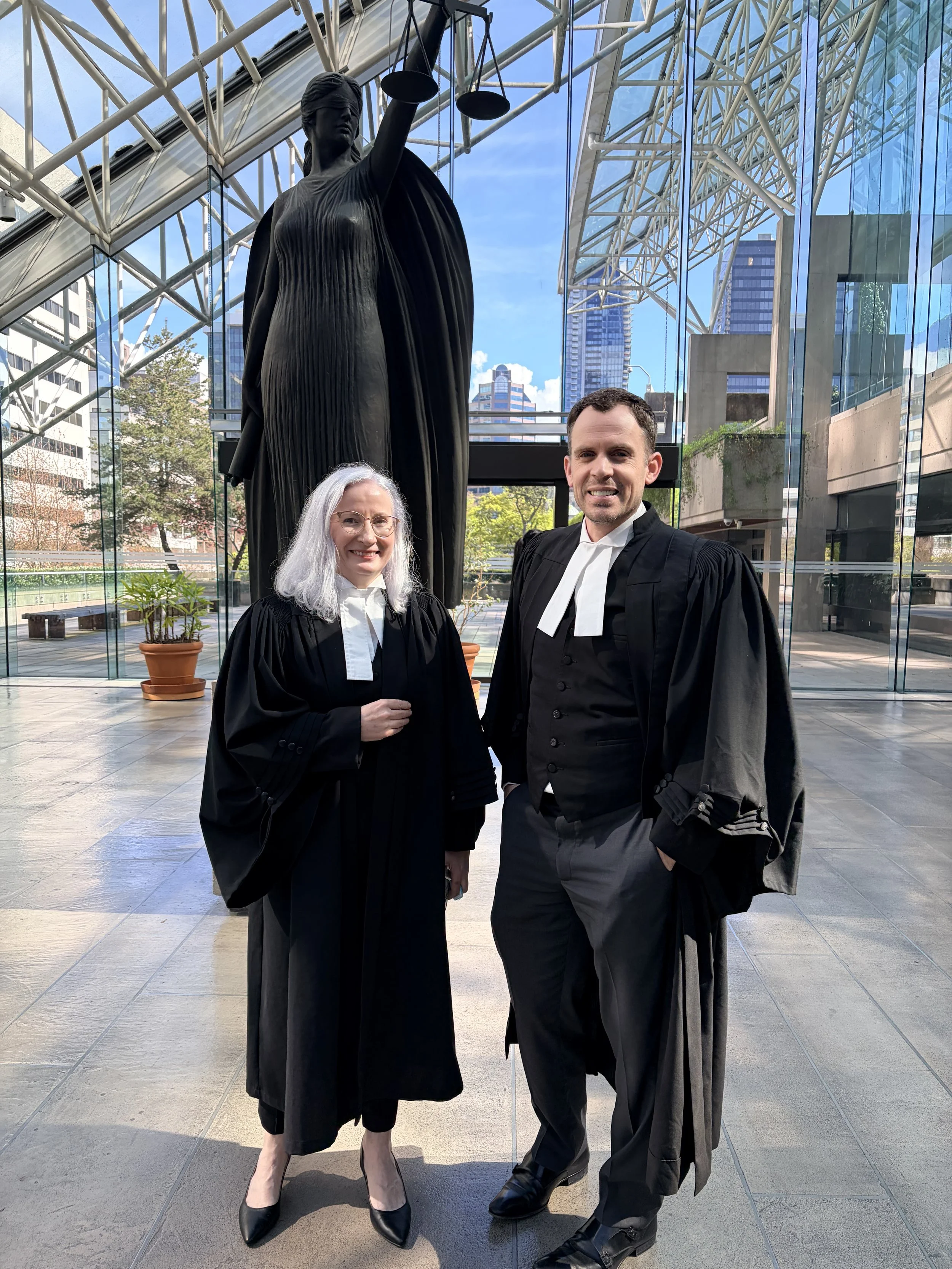
As an association of lawyers situated at the intersection of law and religion, CLF is grateful for the opportunity to assist the Court with a discussion of key constitutional principles.
CLF was represented in this case by Gwendoline Allison (Barton Thaney Law) and André Schutten (pictured left) and Derek Ross.
READ CLF’S FACTUM
FURTHER READING
“Faith-based health care offers vital access to medical assistance in living” by Brian Bird and Derek Ross (The Hub)