
Québec’s Bill 21, the ban of religious symbols, and the enshrinement of state laicity
Since the introduction of Québec’s Bill 21 (An Act respecting the laicity of the State), Christian Legal Fellowship (L’Alliance des chrétiens en droit) has been advocating for the rights of openly religious lawyers and other professionals in Québec who have been affected by the Bill.
““Bill 21 bans many Québecers from wearing religious symbols at work. It therefore violates a foundational right of any free and democratic society: the right to openly and publicly identify as religious. Bill 21 purports to be advancing religious neutrality, but it is promoting the exact opposite: a public square which is hostile, not neutral, toward religion. This is unacceptable.””
state IRRELIGION, NOT state NEUTRALITY
Bill 21, which invokes the notwithstanding clause of both the Québec Charter (section 53) and the Canadian Charter (section 33), was enacted to “enshrine” the “paramountcy of State laicity [in] Québec’s legal order” and prohibits a number of professionals in the public sector from wearing religious symbols – including lawyers who work for, or are under contract with, the provincial government.
This law’s “enshrinement” of state laicity has led to the amendment of other statutes such as the Québec Charter, and has spurred subsequent legislation—both enacted (Bill 94) and proposed (Bill 9)—which rely on this principle to impose further restrictions on religious expression in the province.
Together, these laws demonstrate that laïcité is not contrived merely as an internal government policy, or as a means of implementing the duty of religious neutrality, but to establish a markedly different doctrine for Québec society as a whole, one that effectively imposes irreligion on private citizens, not neutrality on the state and its institutions.
Unlike state neutrality which limits the government’s authority to protect citizens’ rights, Bill 21’s laicity inverts the State’s duty of neutrality by requiring private citizens to abstain from religious expression. In fact, the Québec Court of Appeal found that Bill 21 moves Québec away from religious neutrality, towards laicity (at para 97).
The doctrine of laïcité can now expressly limit the scope and exercise of all rights and freedoms under s. 9.1 of the Québec Charter — not just for government workers, but all private citizens, and not just in their interactions with the State, but with other citizens.
We further see that Québec’s prayer ban (Bill 94, An Act respecting the reinforcement of laicity in Québec) restricts students — not government workers — from praying or engaging in religious activities within public schools.
Now, Québec’s Bill 9 proposes (among other restrictions) to generally ban “all religious practice” in certain public institutions like colleges and universities, and to prohibit “collective religious practice” within any public parks or on public sidewalks and footpaths without prior municipal authorization, which will only be granted “exceptionally and on a case-by-case basis”.
These laws bring into even sharper focus what was already clear at Bill 21’s first reading: the doctrine of laïcité promotes an irreligious doctrine throughout Québec society.
INTERVENTIONS
Bill 21: SUPREME COURT OF CANADA
From March 23 to 26, 2026, the Supreme Court of Canada heard the constitutional challenge to Québec’s ban on religious symbols (Bill 21).
CLF (ACD) intervened as a friend of the court before the Québec Court of Appeal in this matter (see below), and as of right before the Supreme Court of Canada to make submissions on the constitutional division of powers, with particular concern around Bill 21’s application to lawyers, including members of CLF, who openly identify as religious. Read more below, including our factum filed with the Court:
March 25, 2026 - Supreme Court of Canada Hears Constitutional Challenge to Québec’s Ban on Religious Symbols
September 22, 2025 - CLF Intervening in Bill 21 Constitutional Challenge Before Supreme Court of Canada
Click here to read CLF’s factum filed with the Supreme Court of Canada
The hearing has concluded and the Court has reserved its decision.
PRAYER BAN: cour supérieure du québec
CLF (ACD) was granted leave to intervene in litigation challenging the province’s “prayer ban” directive. That directive (now codified in Bill 94), issued by the Québec Minister of Education, prohibits the use of any space in public schools for religious practices, including “overt prayers”. Read more below:
27 July 2023 - Defending Students’ Right to Pray
8 May 2023 - Quebec Bans Student-Initiated “Religious Practices” Such As “Overt Prayers” in Public Schools
The hearing of this matter has been paused pending the outcome of the Bill 21 appeal before the Supreme Court of Canada.
Bill 21: Court of Appeal for QuÉbec
CLF (ACD) was granted leave to intervene in the litigation challenging Québec’s Bill 21 at the Court of Appeal for Québec. Read more below, including our factum filed with the Court:
29 février 2024 - Cour d’appel du Québec rend sa décision sur la Loi 21
29 February 2024 - Quebec Court of Appeal Releases Bill 21 Decision
16 décembre 2022 - Rapport d’audience sur le projet de loi 21
6 December 2022 - Bill 21 Hearing Report
4 novembre 2022 - Appel de la Loi 21 : L’ACD intervient en faveur de l'égalité religieuse
4 November 2022 - Bill 21 Appeal: CLF Intervenes in Support of Religious Equality
17 March 2022 - L’ACD dépose son mémoire dans le litige contre le projet de loi 21 / CLF files factum in Bill 21 litigation
CLF’s Advocacy
BILL 9: BRIEF TO NATIONAL ASSEMBLY COMMITTEE ON CITIZEN RELATIONS
CLF (ACD) denounces Québec’s Bill 9, which proposes to generally ban “all religious practice” in certain public institutions like colleges and universities, and to prohibit “collective religious practice” within any public parks or on public sidewalks and footpaths without prior municipal authorization. It also proposes a number of other restrictions, including revoking and/or denying accreditation for subsidies for religious private schools.
Bill 9 defines “religious practice” very broadly to include “any action, except the wearing of a religious symbol, that may reasonably constitute, in fact or in appearance, the manifestation of a religious conviction or belief”.
Read more, including CLF’s Brief to to the National Assembly’s Committee on Citizen Relations:
6 May 2026: Québec Passes Bill 9
3 February 2026: Defending Campus and Religious Expression in Québec
3 février 2026: Défendre le ministère universitaire et l’expression religieuse au Québec
BILL 21: Submissions to the National Assembly
Christian Legal Fellowship was one of the first legal organizations in Canada to denounce Bill 21. Our written submission to Québec’s legislative committee was endorsed by 116 lawyers, law students, and retired jurists from Québec and across Canada.


"Controversial Bill 21 demands irreligious uniformity, opposite of neutrality” - The Lawyer’s Daily
Legal updateS

Public Engagement
“Banning student-initiated prayer in school spaces is unconstitutional, and unjust” - The Globe and Mail
“Religious Rights” - Canadian Justice
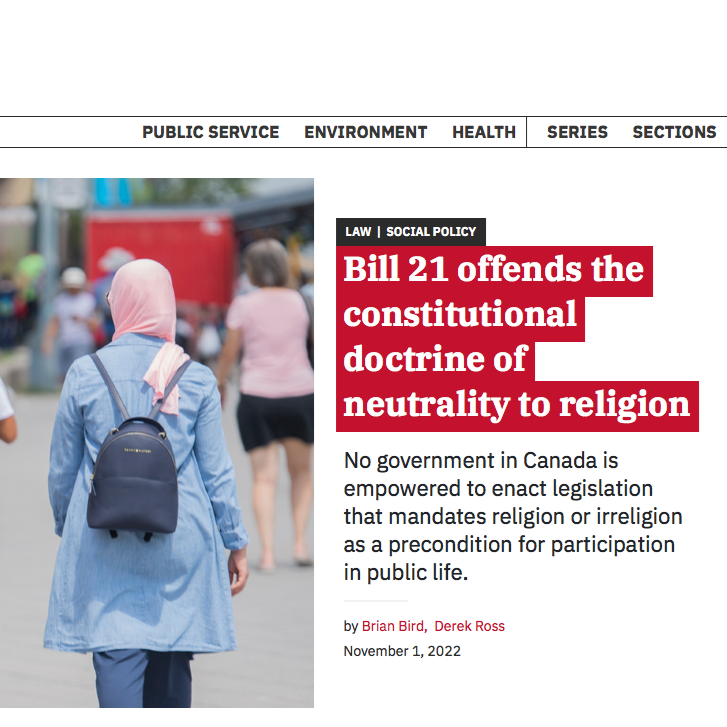
“Bill 21 offends the constitutional doctrine of neutrality to religion” by Prof. Brian Bird and Derek Ross - Policy Options


“The Ban on Religious Symbols” - Canadian Justice
“Religious expression is under attack in Canada – and not just in Quebec” - The Globe and Mail
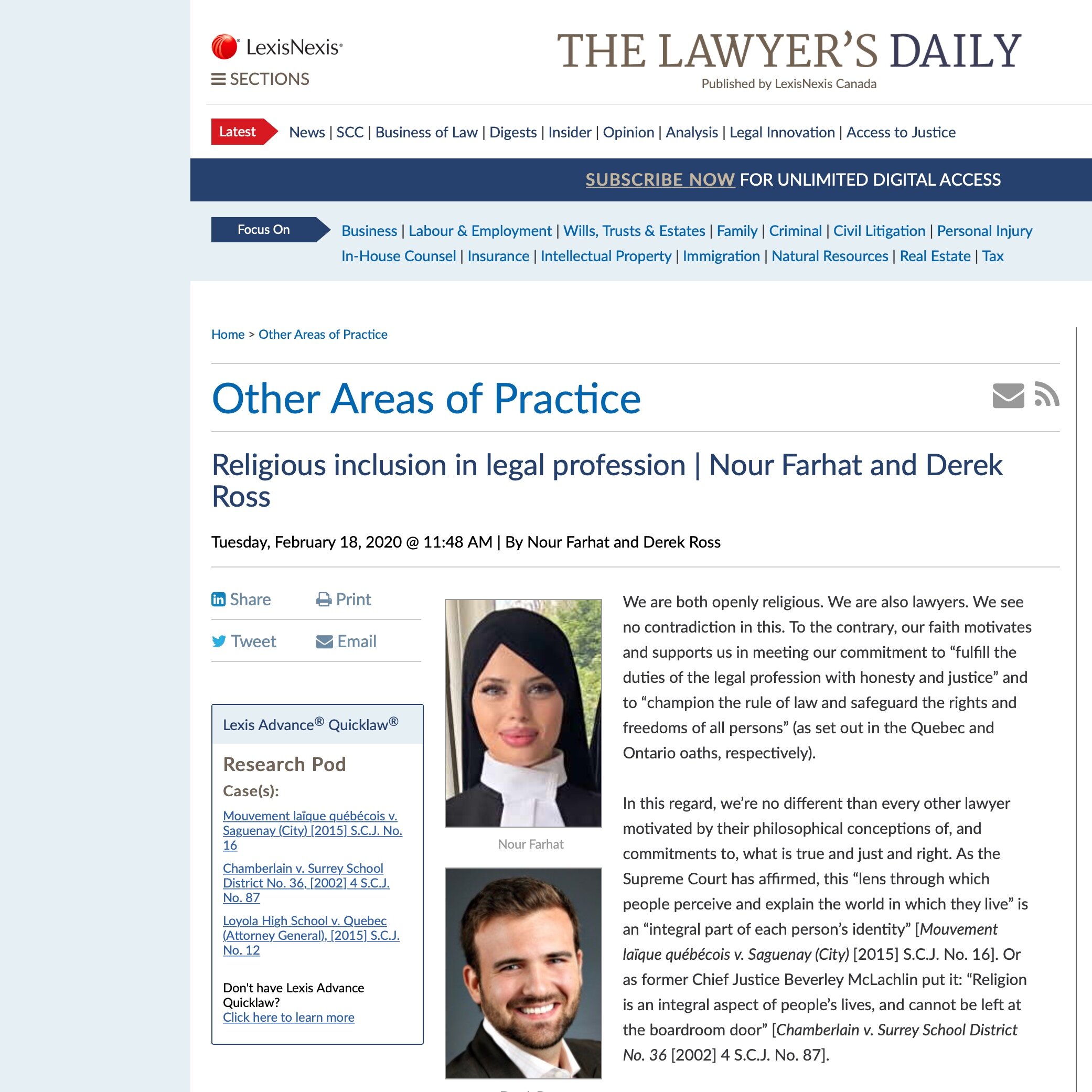
“Religious inclusion in legal profession” - The Lawyer’s Daily
”Defending human rights starts at home” - The Lawyer’s Daily
In the media
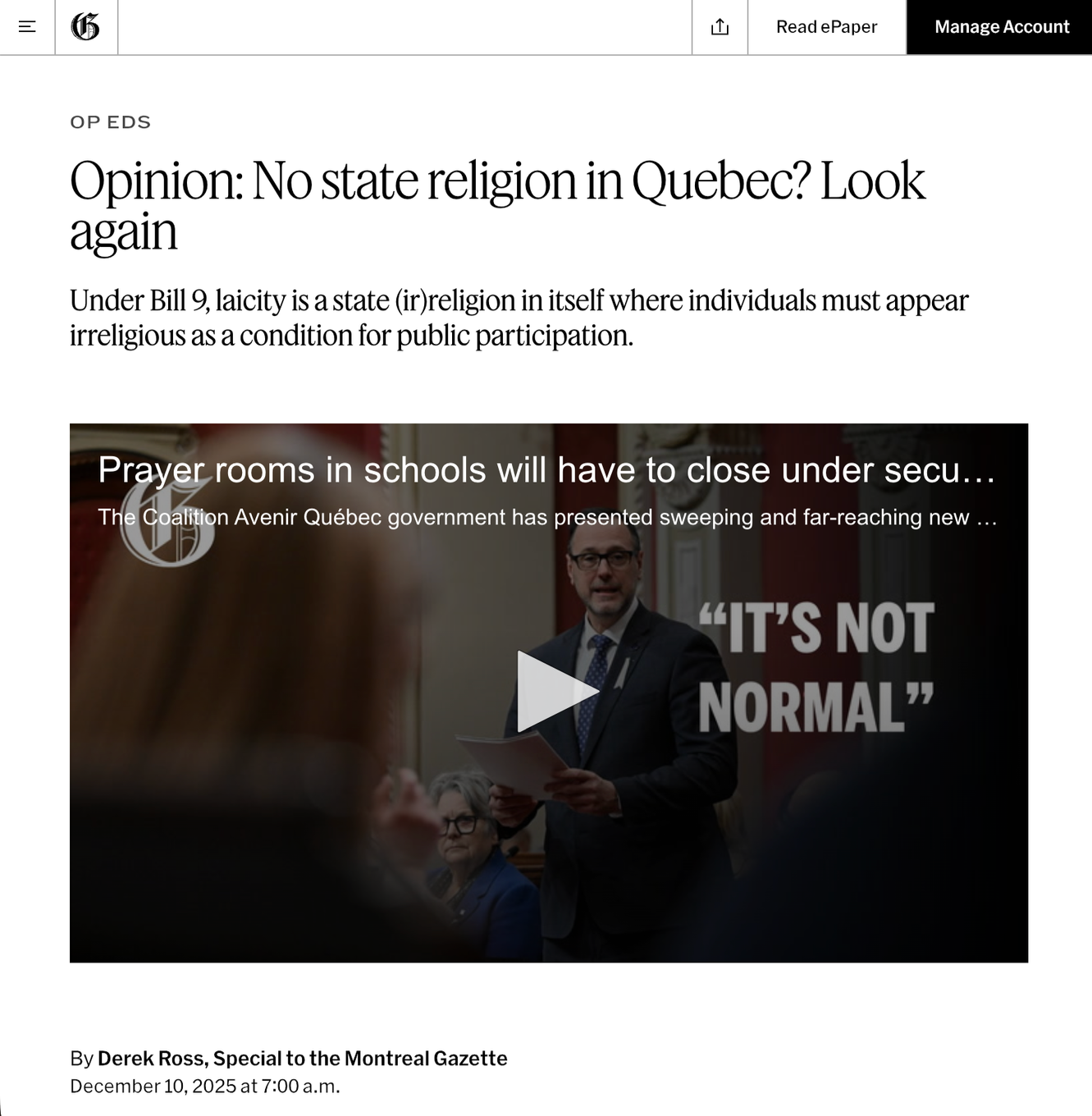
Opinion: No state religion in Québec? Look again - The Montreal Gazette, December 2025
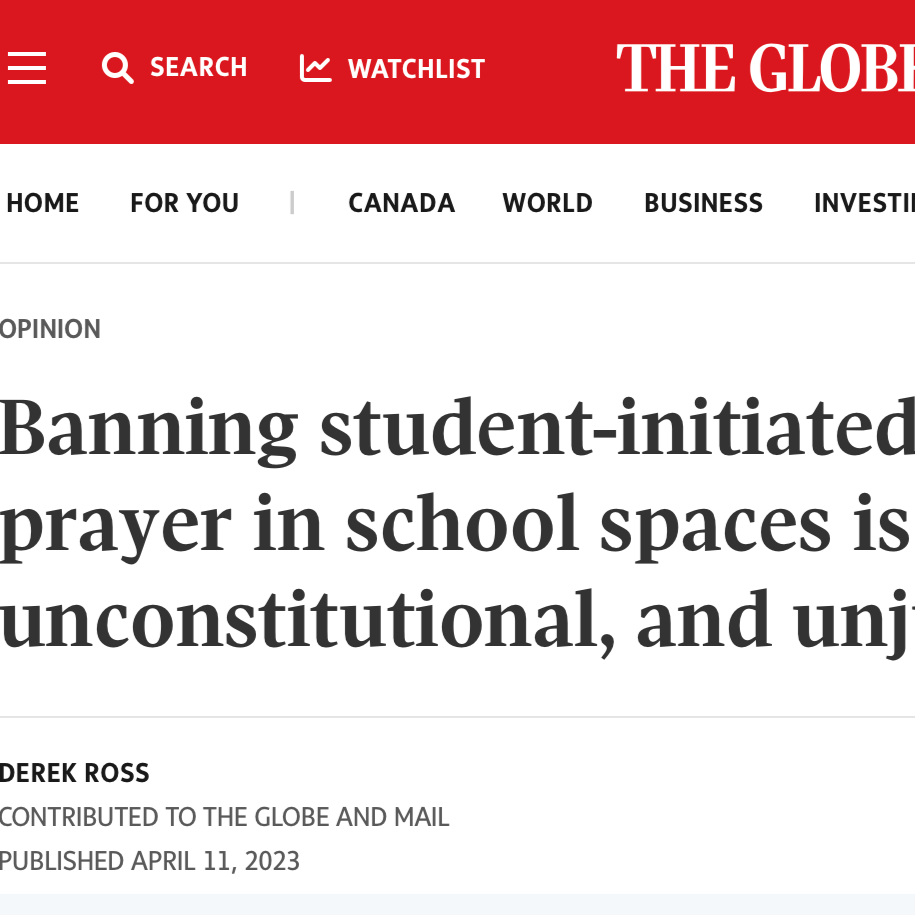
Banning student-initiated prayer in school spaces is unconstitutional, and unjust - The Globe and Mail, April 2023
Bill 21 offends the constitutional doctrine of neutrality to religion - Policy Options, November 2022
The Ban on Religious Symbols - Canadian Justice, May 2021
La pénurie de profs aggravée par la loi 21 - La Converse, 9 octobre 2020
Christian Legal Fellowship defends human rights - for all faiths - Church for Vancouver, March 4, 2020
Commitment to religious equality - CBA National, January 15, 2020
'A clear message:' Injunction against religious symbols law struck down - CHVN Radio, August 6, 2019
Quebec’s forced passage of secularism Bill 21 decried as ‘unconscionable’ - Canadian Catholic News, June 18, 2019
Canada bans most government officials from wearing religious symbols - EWTN, June 18, 2019 (video interview with Derek Ross)
Controversial Bill 21 demands irreligious uniformity, opposite of neutrality - Law360, June 2019
Quebec passes Bill 21 in face of opposition - Canadian Catholic News, June 14, 2019