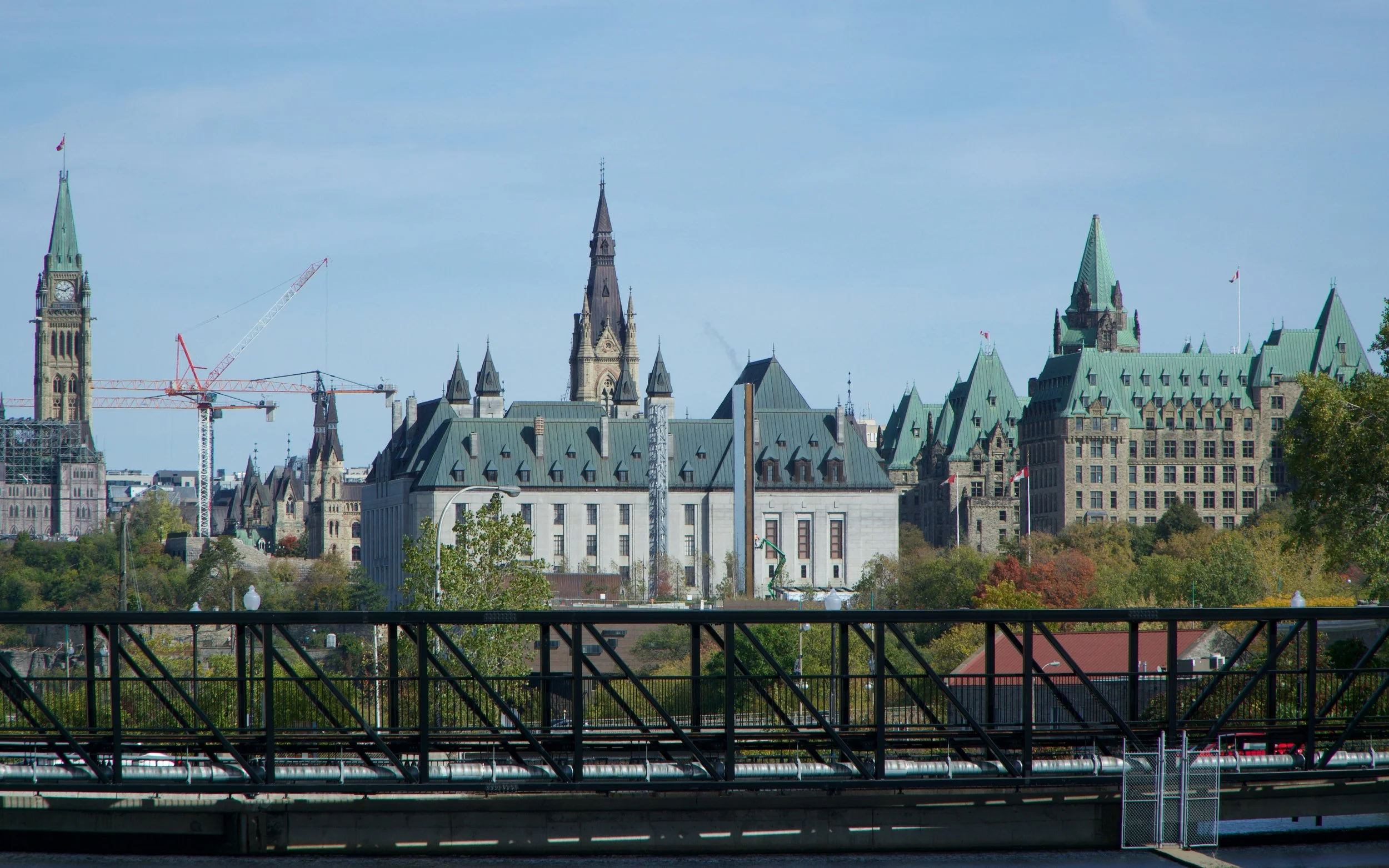
From March 23 to 26, 2026, the Supreme Court of Canada is hearing the constitutional challenge to Québec’s ban on religious symbols, An Act respecting the laicity of the State (Bill 21).
This law, which invokes the notwithstanding clause of both the Québec Charter (section 53) and the Canadian Charter (section 33), was enacted to “enshrine” the “paramountcy of State laicity [in] Québec’s legal order” and prohibits a number of professionals in the public sector from wearing religious symbols – including lawyers who work for, or are under contract with, the provincial government.
CLF intervened as a friend of the court before the Québec Court of Appeal in this matter, and intervened as of right before the Supreme Court of Canada to make submissions on the constitutional division of powers, with particular concern around Bill 21’s application to lawyers, including members of CLF, who openly identify as religious.
CLF’s Oral Arguments
On March 25, Christian Legal Fellowship (CLF)’s Executive Director and General Counsel, Derek Ross, made oral submissions to the Supreme Court. You can read CLF’s Outline of Oral Argument filed with the Court here. You can also read CLF’s factum (written argument) here.
Below is a summary of CLF’s oral submissions:
a Province has no authority to restrict religious expression solely to promote the majority’s religious or irreligious doctrine
Under the division of powers in the Constitution Act, 1867, a province does not have authority to restrict citizens’ religious expression solely to promote the majority’s religious (or irreligious) doctrine. This is not a new or revolutionary idea, nor a contraction of provincial authority, but a long-established constitutional limit that stands independently of the notwithstanding clause.
While a provincial law can affect morality and religion in pursuit of an otherwise valid provincial subject matter, restricting religious expression solely to promote the state’s preferred doctrine is not one such subject. The Supreme Court made clear in Edwards Books (see para 61) that a law which seeks to enforce or encourage religious observance to promote a majoritarian morality is beyond provincial authority.
This is why, CLF argued, Bill 21 is unconstitutional: according to the trial judge, it excludes lawyers who wear religious symbols solely because of their religious nature, in order to promote irreligious secularism instead (see paras 367-70).
This promotion of an irreligious doctrine is brought into even sharper focus when examining the Bill’s legal effects, as cases like Murray Hall guide courts to do (para 25), leading to CLF’s second submission:
The Law’s Purpose and Effects are to impose irreligion, not neutrality, throughout society
In examining the law’s pith and substance (which considers both a statute’s purpose and its effects), the term laïcité should be presumed to have the same meaning across related statutes (see Vavilov, para 44). It is helpful, therefore, to look to the various statutes that Bill 21 amends (such as the Québec Charter), and those which rely on its enshrinement of laïcité (such as Bill 94), to further clarify what Bill 21’s conception of laïcité entails.
These clarify that laïcité is not contrived merely as an internal government policy, or as a means of implementing the duty of religious neutrality, but to establish a markedly different doctrine for Québec society as a whole, one that effectively imposes irreligion, not neutrality.
For example, the doctrine of laïcité can now expressly limit the scope and exercise of all rights and freedoms under s. 9.1 of the Québec Charter — not just for government workers, but all private citizens, and not just in their interactions with the State, but with other citizens. So, unlike state neutrality which limits the government’s authority to protect citizens’ rights, Bill 21 has inversed this to allow laïcité to restrict citizens’ rights in order to advance the State’s.
We further see that the Act respecting the reinforcement of laicity in Québec (Bill 94) restricts students — not government workers — from praying or engaging in religious activities within public schools.
These and other statutes highlight how Bill 21’s laïcité promotes an irreligious doctrine throughout Québec society. In fact, the Québec Court of Appeal found that Bill 21 moves Québec away from religious neutrality, towards laïcité (at para 97).
Bill 21’s laïcité is not state neutrality as articulated by the Supreme Court in Saguenay, which requires the equal inclusion of all — religious and non-religious — identities in public institutions. Neutrality seeks to accommodate religious differences, not to homogenize or extinguish them. Bill 21’s laïcité does the opposite: it excludes openly-religious identities from these spaces, solely because they are openly-religious, which is why CLF and others argue it is a form of state-promoted irreligion.
But as the Supreme Court has consistently recognized, in our country, there is no state-established religion (or irreligion). This is an important consideration in response to arguments surrounding federalism (i.e. that provinces must be free to chart their own course within a unified Canada). That Canada has no state-established religion or irreligion has been a defining feature of our Dominion since Confederation in 1867. It would require more than a majority vote of a single provincial legislature to change that today.
WATCH THE WEBCAST
Listen below to Derek Ross’ oral arguments on behalf of Christian Legal Fellowship. Access the full webcast of the hearing on the Supreme Court of Canada’s website (CLF’s submissions begin at 1:34:27 on March 25, 2026).
Read CLF’s Outline of Oral Argument
LEARN MORE
Read CLF’s factum and learn more about the intervention before the Supreme Court of Canada
Read CLF’s report on the Québec Court of Appeal decision (EN/FR)
Read CLF’s Bill 21 Hearing Report from the Québec Court of Appeal (EN/FR)
Read more about CLF’s intervention before the Québec Court of Appeal (EN/FR)
Read more on CLF’s advocacy on Bill 21 in Québec since 2019
Read more on Québec’s 2023 ban of student-initiated religious practices on school grounds
Read more on Québec’s Bill 9 and CLF’s submission to